Beginner AI
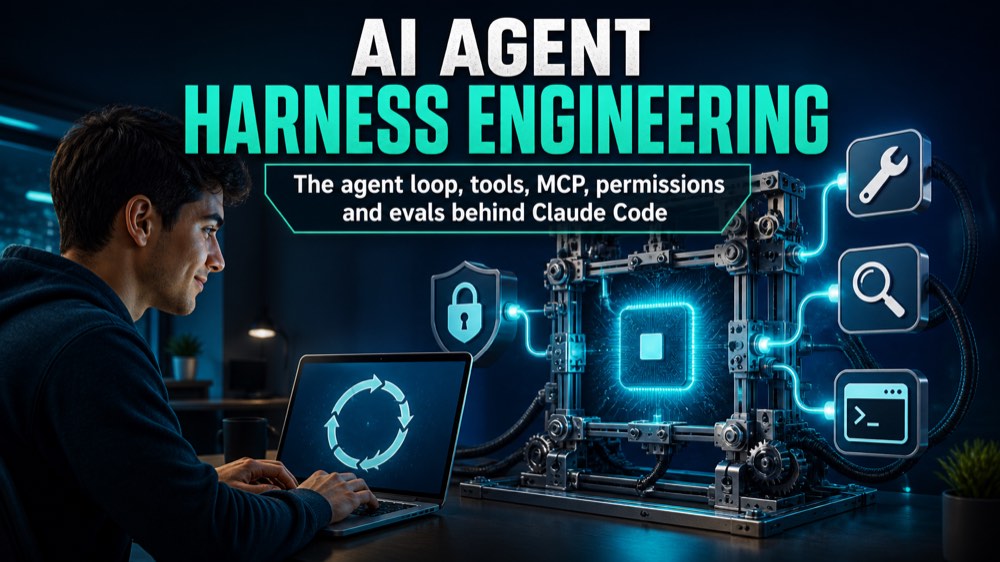
AI Agent Harness Engineering
The model is only half of an agent. The other half is the harness: the code that runs the loop, executes tools, decides what enters the context window, asks a human before risky actions and keeps a record of every step. In five lessons with Prof. Daniel you learn how a harness works and how to build one: the agent loop and its stop conditions, tool design and context engineering, permissions, sandboxing and prompt-injection defense, sub-agents and orchestration, and evals, tracing and cost control. Claude Code is the real-world example; the Claude Agent SDK and the OpenAI Agents SDK show how the same ideas look in code. For developers who already call an LLM API.
5 modules 5 lessons 3 h 150 questions
Course content
1 The Agent Loop 1 lesson · 6 min
2 Tools and Context Engineering 1 lesson · 6 min
3 Permissions, Sandboxing and Prompt Injection 1 lesson · 6 min
4 Sub-agents and Orchestration 1 lesson · 7 min
5 Evals, Tracing and Cost Control 1 lesson · 6 min
Tips
See all
Evals and Cost
Keep the start of your prompt stable so it can be cached
A steady prefix makes repeat turns cheaper and faster.
Evals and Cost
Trace every model call and tool call, then read them
You cannot fix an agent whose steps you cannot see.
Evals and Cost
Turn every production failure into an eval case
A failure you have seen once should never surprise you twice.
Orchestration
Reach for multi-agent only on broad, parallel work
More agents means more tokens, so earn the extra cost.