WBF Academy
Machine Learning Fundamentals

Machine Learning Fundamentals

Beginner

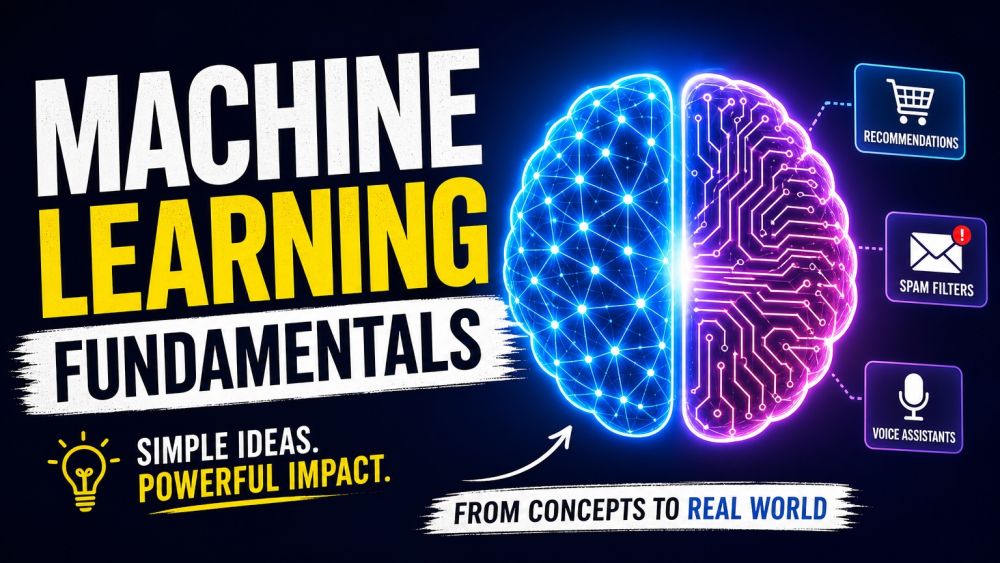
Machine learning powers the recommendations, spam filters, and voice assistants you use every day, but the ideas behind it are simpler than the hype suggests. This course builds your understanding from the ground up, with plain-language explanations and real-world intuition instead of dense math or coding exercises. You will start by learning what machine learning actually is and how it differs from traditional programming — teaching a system with examples instead of writing explicit rules — and the key difference between supervised, unsupervised, and reinforcement learning. From there you will explore supervised learning in depth: how models like linear regression, logistic regression, decision trees, and k-nearest neighbors learn to predict outcomes from labeled examples. You will then learn how to tell if a model is actually any good — train/test splits, accuracy, precision and recall, and the classic traps of overfitting and underfitting that quietly ruin real projects. Next you will explore unsupervised learning and get a gentle, intuitive introduction to neural networks and deep learning, the technology behind today's most advanced AI. Finally you will connect it all to practice — the full workflow from raw data to a working model, feature engineering, common pitfalls, and the ethical questions every practitioner needs to consider, like bias and fairness. By the end you will think clearly about machine learning, understand what these models can and cannot do, and be ready to go deeper into any specific technique with confidence.

📋 5 tracks ❓ 200 questions 💡 15 tips 🎬 7 videos ⏱ ~6h

Videos

See all

Tracks

Before you can understand any specific technique, you need a solid mental model of what machine learning actually is. This track starts by contrasting machine learning with traditional programming — instead of writing explicit rules, you feed a system examples and let it find the patterns itself. You will learn the three major families of machine learning — supervised, unsupervised, and reinforcement learning — and when each one applies. You will also learn the core vocabulary every model depends on: features, labels, and the crucial split between training data and test data used to check whether a model actually learned something useful. By the end you will recognize what kind of problem you are facing and speak the language of machine learning with confidence.

Supervised learning is the workhorse behind most real-world machine learning applications, and this track builds your intuition for how it works. You will learn the fundamental split between regression, predicting a number, and classification, predicting a category, and see how the same underlying idea powers both. You will explore linear regression and logistic regression as intuitive starting points, then move on to decision trees, which mimic the way humans make step-by-step choices, and k-nearest neighbors, which predicts by looking at similar past examples. Throughout, the focus stays on intuition rather than formulas — what each model is actually doing and why it makes the predictions it does. By the end you will recognize these algorithms by name and understand their core logic.

Building a model is only half the job — knowing whether it actually works is what separates a useful model from a dangerous one. This track teaches you to evaluate machine learning models the way practitioners do. You will learn why splitting data into a training set and a test set is essential, and how metrics like accuracy, precision, and recall tell very different stories about a model's performance, especially when classes are imbalanced. You will learn to recognize overfitting, when a model memorizes its training data instead of learning general patterns, and underfitting, when a model is too simple to capture what matters, along with the bias-variance tradeoff that explains both. You will also learn cross-validation, a more reliable way to test a model. By the end you will judge any model's quality with confidence.

Not all machine learning starts with labeled answers — this track explores what happens when a model has to find structure on its own, and takes your first steps into deep learning. You will learn clustering, the task of grouping similar data points together, and walk through k-means, the most widely used clustering algorithm, to see how it discovers groups without being told what they are. You will also learn dimensionality reduction, a technique for simplifying complex data while preserving what matters most. From there you will get a gentle, intuitive introduction to neural networks — how layers of simple units combine to learn complex patterns — and a first look at deep learning, the technology behind today's most powerful AI systems. By the end you will understand these ideas conceptually, without needing to write a line of code.

Understanding algorithms is not the same as knowing how to actually build something with them — this final track connects theory to practice. You will walk through the real-world machine learning workflow, from defining a problem and gathering data to training, evaluating, and deploying a model. You will learn data preparation, cleaning and organizing raw data so a model can actually learn from it, and feature engineering, the art of shaping raw information into the signals a model needs to succeed. You will learn to recognize the pitfalls that derail real projects — data leakage, biased samples, and misleading metrics — and finish with a clear look at ML ethics, including how bias creeps into models and why fairness has to be a deliberate design choice, not an afterthought. By the end you will see the full path from raw data to a responsible, working model.

Certification Exam

🏆

Certification Exam

Machine Learning Fundamentals

30
Questions
45m
Time Limit
% 70%
To Pass

All tracks · No time pressure to start

🏆

Certification Exam

Machine Learning Fundamentals

#

30 Questions

All difficulty levels

45 Minutes

Auto-submits when time expires

%

70% to Pass

Earn your certification badge

No Going Back

Once you answer, you move forward

Tips

See all