
Storytelling & Influence
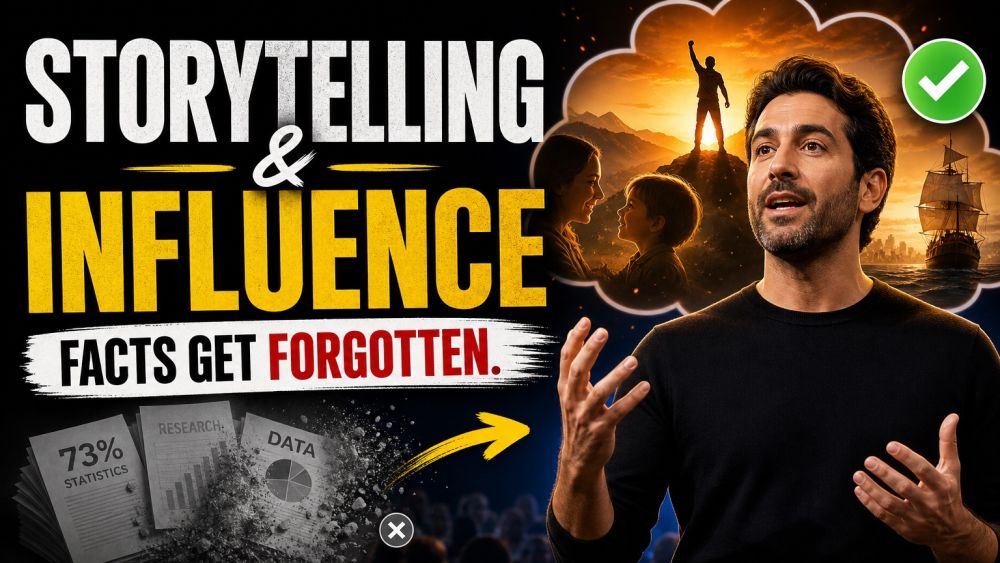
BeginnerFacts get forgotten. Stories get remembered, repeated, and acted on — and the people who move rooms, close deals, and lead teams almost always know how to tell one. This beginner course teaches you the craft of storytelling and influence, no natural talent required. You will start by understanding why stories work: how they beat facts for persuasion, why they stick in memory when data slides right off, and how a message survives (or mutates) as it travels from person to person. From there you learn the structure every great story shares — setup, conflict, resolution — and how vivid detail and a relatable hero turn a flat account into something people lean into. You will build real connection before you ever try to convince: rapport, mirroring, and listening past the words to what someone actually means. You will learn to speak to identity and values, not just facts, so your message lands where decisions really get made. Finally you will shape your own stories and use them in talks, pitches, and interviews. Whether you lead a team, sell an idea, or just want to be the person others remember, this course gives you a repeatable way to connect, inspire, and influence with story.
Videos
See allTracks
Before you tell a single story, you need to know why stories work at all. This track opens with the science and psychology behind storytelling: why a good story persuades more reliably than a spreadsheet full of facts, and why people remember a story days or weeks after they have forgotten every statistic in the same talk. You will also see what happens to a message as it travels — how details drop out, get exaggerated, or shift with each retelling, and what that means for how you should craft yours. By the end you will understand stories as memory anchors, the reason a well-placed story outlasts any list of bullet points.
Every story that grips an audience shares the same bones. This track teaches the classic arc — setup, conflict, and resolution — and shows you how to build each part so tension actually builds instead of fizzling. You will learn to create a hero your audience can relate to, someone whose stakes feel real, and how a touch of genuine tension keeps people leaning in instead of checking their phones. You will also practice adding vivid, specific detail and illustration, the sensory texture that makes a story feel lived rather than summarized. By the end you will be able to take any raw experience and shape it into a story with a real shape.
People buy into people before they buy into ideas, which is why this track is about connection, not technique. You will learn to build rapport quickly and genuinely, and pick up mirroring and matching, the basic NLP techniques that make someone feel instantly at ease with you. You will practice listening at a deep level — hearing what a person means, not just the words they use — and learn to read an audience in real time, sensing when they are engaged, confused, or checked out. These are the same skills that make great storytellers feel trustworthy before they even start their story. By the end you will connect first and convince second, every time.
Facts change minds for a moment; identity and values change them for good. This track introduces the neurological levels of change — environment, behavior, capability, values, and identity — a simple model for understanding why some messages barely register while others reshape how someone sees themselves. You will learn to craft a message that reaches values and identity, not just behavior, so your story lands somewhere durable. You will also learn to anchor emotion inside a story, tying a feeling to a moment so it resurfaces whenever your audience recalls it. By the end you will speak to what people actually care about, and your influence will last far longer.
Knowledge only pays off once you use it, so this final track puts everything to work. You will learn how to bring stories into talks, pitches, and interviews — the exact moments where a well-placed story changes the outcome. You will find the true stories already sitting in your own life and shape them into tools you can reuse: a leadership story, a failure story, a turning-point story. You will also practice delivery — pacing, pauses, and presence — so a good story on paper becomes a compelling one out loud. By the end you will have your own small library of stories, ready whenever you need to connect, inspire, or persuade.
Certification Exam
Certification Exam
Storytelling & Influence
All tracks · No time pressure to start
Certification Exam
Storytelling & Influence
30 Questions
All difficulty levels
45 Minutes
Auto-submits when time expires
70% to Pass
Earn your certification badge
No Going Back
Once you answer, you move forward
Tips
See allBuild a Personal Story Bank
Collect and organize your best stories before you need them
Turn a Failure Into a Teaching Story
Your worst moments often make your most useful stories
The 60-Second Story for Any Meeting
Keep a tight, ready story for when time is short
Let the Audience Draw Their Own Conclusion
A moral you state feels preachy; one they discover feels earned