

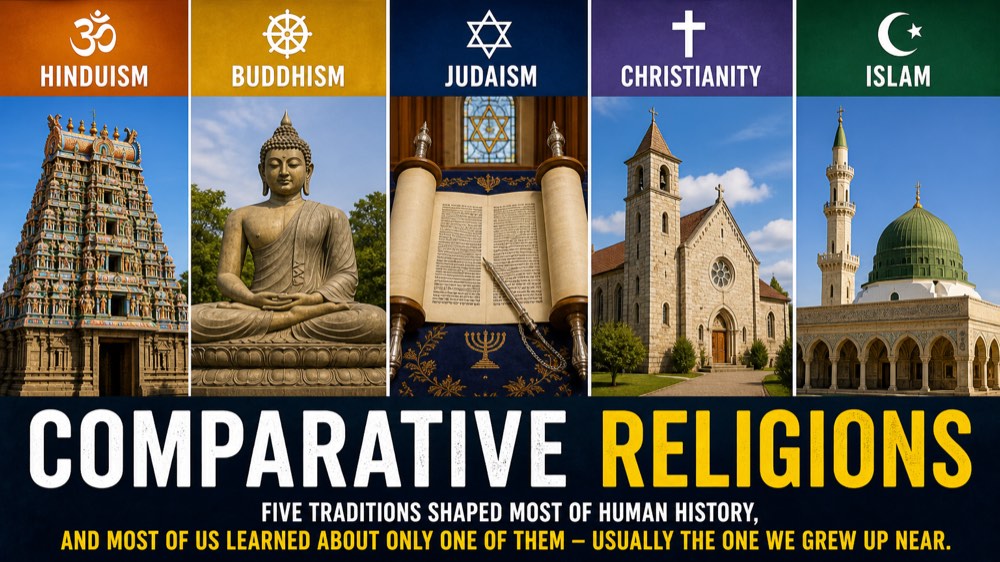
Comparative Religions
BeginnerFive traditions shaped most of human history, and most of us learned about only one of them — usually the one we grew up near. This course sets Judaism, Christianity, Islam, Hinduism and Buddhism side by side and describes each one as its own adherents would recognise it: where it began, what it reads, what it does, and what it asks of a person. You start with the method itself — what the word "religion" is actually doing, and the dimensions a fair comparison uses: narrative and myth, ritual, ethics, doctrine, experience, community and material culture. Then you take each tradition in turn. Judaism: covenant and Torah, the Second Temple and its destruction in 70 CE, the rabbinic turn that produced the Mishnah and the Talmud, and a practice built around Shabbat, the calendar and the life cycle. Christianity: Jesus in his Jewish setting, the Gospels and Paul, how a canon and the creeds were formed, the divisions of 1054 and 1517, and the sacramental life of the branches today. Islam: revelation received from 610 CE, the Qur'an as recited scripture, hadith and sunnah, the succession question behind the Sunni and Shia distinction, and the Five Pillars as the shape of ordinary devotion. Hinduism: shruti and smriti, brahman and atman, karma, samsara and moksha, the great deities and their traditions, puja and festival. Buddhism: Siddhartha Gautama, the Four Noble Truths, the Eightfold Path, the teaching of no fixed self, and the three vehicles that carried it across Asia. The last part of the course is the comparison the rest was built for: creation accounts read against each other, revealed scripture against remembered scripture, the shared grammar of ritual — purity, prayer, pilgrimage, food, calendar — and the ethical core each tradition states in its own words, from tzedakah and caritas to zakat, dana and seva. Throughout, the course describes and does not adjudicate: it will not tell you which tradition is true, and it will not caricature any of them. What it offers is religious literacy — the ability to read a practice, a text or a festival and know what you are looking at.
Course content
Certification Exam
Certification Exam
Comparative Religions
🔒 Unlock the exam
Complete the requirements above to unlock the exam
Certification Exam
Comparative Religions
30 Questions
All difficulty levels
45 Minutes
Auto-submits when time expires
70% to Pass
Earn your certification badge
No Going Back
Once you answer, you move forward
Tips
See allThe Buddha's core insight came from rejecting two different extremes, not from choosing one
The Middle Way sits between luxury and self-denial, not somewhere in between ...
Theravada, Mahayana and Vajrayana are not three different Buddhas — they're three different vehicles
The word "yana" means "vehicle," describing a path to the same destination
The single sharpest disagreement between Hinduism and Buddhism is about whether you have a permanent self
Atman affirms one; anatta denies it
Calling Hinduism "polytheistic" skips over what most Hindu philosophy actually says about the deities
Many traditions treat the many gods as expressions of one underlying reality,...