

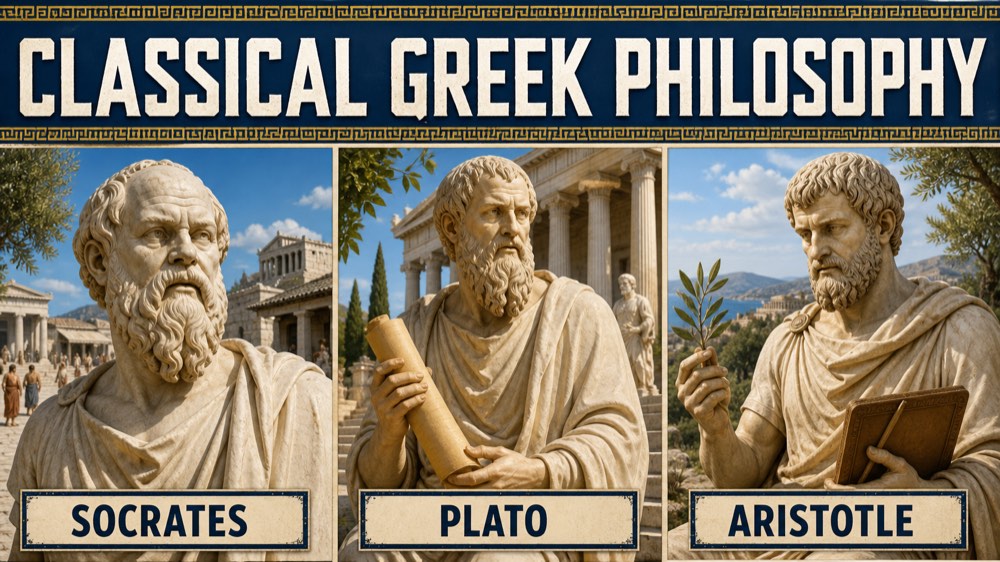
Classical Greek Philosophy
BeginnerThree Athenians who knew each other — Socrates taught Plato, Plato taught Aristotle — set the terms almost every later argument about ethics, politics and knowledge would use. This course reads them as working thinkers rather than statues, and it keeps asking the question a beginner deserves: what does this change about Monday morning? You start with the shift from mythos to logos, the pre-Socratic move from telling stories about the world to giving reasoned accounts of it, and with Socrates himself: a man who wrote nothing, who cross-examined his fellow Athenians in the market with a procedure called the elenchus, and whose famous wisdom was knowing that he did not know. You follow him to the trial of 399 BCE, the charges of impiety and corrupting the young, the jury of 501, and the argument in the Crito for staying to face a verdict he thought unjust. Then the ethics. Aretē means excellence at a thing's proper work, not moral respectability, and Aristotle's function argument asks what the proper work of a human being could be. Eudaimonia is flourishing across a whole life, not a mood. Virtue is a stable state built by habituation, and the mean between deficiency and excess is relative to the person and the situation — not a recommendation of mildness, and explicitly not available for every act. Weakness of will gets a track of its own: Socrates denied it was even possible, Aristotle explained how it happens, and phronēsis — practical wisdom — is the capacity that closes the gap between knowing and doing. In politics you read the Republic's hard question, why be just when injustice pays, its tripartite soul, its city–soul analogy and its philosopher-rulers, along with the objections readers have raised ever since; then Aristotle's Politics, the human being as a political animal, the polis existing for living well rather than merely living, six constitutions and their deviations, and the stabilising middle group. In epistemology you get Plato's Forms and the allegory of the cave read for what it actually argues about education, alongside Aristotle's empirical turn, the four causes and the syllogism that started formal logic. The last two episodes bring all of it back to ordinary life: building a habit, judging a case no rule covers, sorting friendships by what they are actually for, handling anger as a mean, and using the elenchus on your own beliefs instead of on someone else's.
Course content
Certification Exam
Certification Exam
Classical Greek Philosophy
🔒 Unlock the exam
Complete the requirements above to unlock the exam
Certification Exam
Classical Greek Philosophy
30 Questions
All difficulty levels
45 Minutes
Auto-submits when time expires
70% to Pass
Earn your certification badge
No Going Back
Once you answer, you move forward
Tips
See allAristotle sorts friendship into three kinds, and only one of them can actually last
Friendships of utility and of pleasure dissolve when the usefulness or the fu...
Aristotle's four causes answer four different questions about the same thing, not four separate explanations competing for one answer
Material, formal, efficient and final causes ask what something is made of, w...
The cave in Plato's Republic is not a plot twist about a simulation — it's an argument about education
Book VII stages the prisoner's turn and ascent as what philosophical educatio...
Doxa and episteme are two different relationships to truth in Plato, not two levels of confidence
Opinion can be true by accident; knowledge, on Plato's account, has to be tet...