

North America
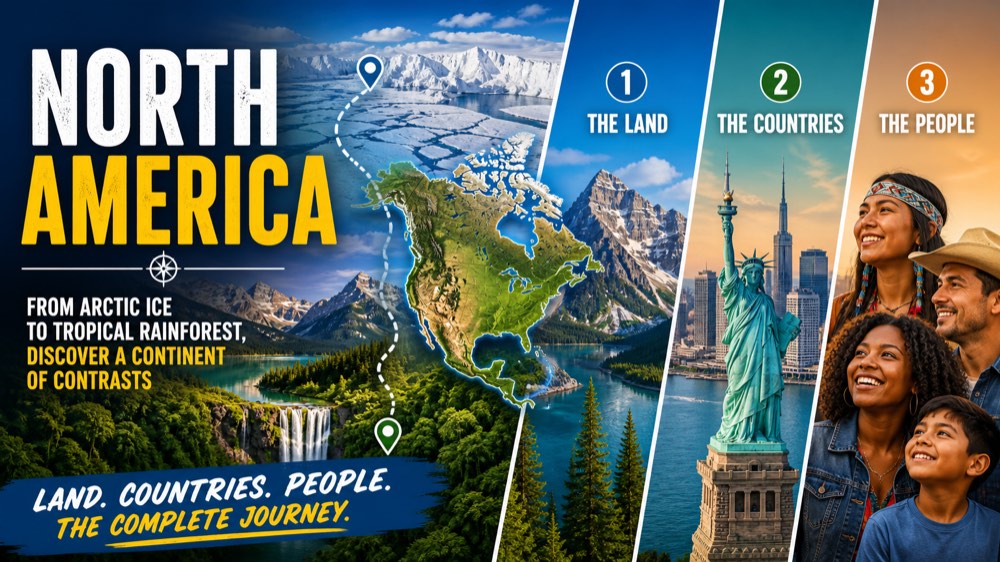
BeginnerA continent that runs from the permanent ice of Ellesmere Island to the rainforest of Panama, and the course follows it in that order: first the land, then the countries standing on it, then the people. You start with the shape of the place — the Rocky Mountains and the ancient, worn Appalachians, the Canadian Shield that four ice ages scraped bare, the Great Plains, the Mississippi that drains about 40 percent of the contiguous United States, and the five Great Lakes that hold a fifth of the planet's surface fresh water. From that you get the climates, because relief is what makes them: why the Pacific coast is wet and the land just east of the mountains is dry, why hurricanes arrive from the southeast and tornadoes form in the middle, and why the Arctic north and tropical south belong to the same landmass. Then the three big countries, one at a time: the United States region by region and how it became the economy it is; Canada, the second-largest country on Earth, whose people live almost entirely within 200 kilometres of one border; Mexico and the seven countries of Central America, from the volcanic spine to the isthmus that split an ocean in two. The last track is the part atlases leave out — the nations who were here first and are still here, the Nahua, Maya, Cree, Navajo, Inuit and hundreds more, and the migrations that made this the most linguistically mixed continent on the planet, ending in the cities where most North Americans now actually live.
Course content








Certification Exam
Certification Exam
North America
🔒 Unlock the exam
Complete the requirements above to unlock the exam
Certification Exam
North America
40 Questions
All difficulty levels
90 Minutes
Auto-submits when time expires
75% to Pass
Earn your certification badge
No Going Back
Once you answer, you move forward
Tips
See allMore than eight in ten North Americans now live in a city
A continent once defined by farms, mountains and forest is, in practice, an u...
North America is one of the most linguistically diverse continents on Earth
Hundreds of Indigenous languages, plus the layers every wave of immigration a...
The Trail of Tears was a forced march, not a migration
The Indian Removal Act of 1830 pushed tens of thousands of people west, and t...
Horses were extinct in the Americas until the Spanish brought them back
Horses evolved in North America, vanished 10,000 years ago, and returned only...