

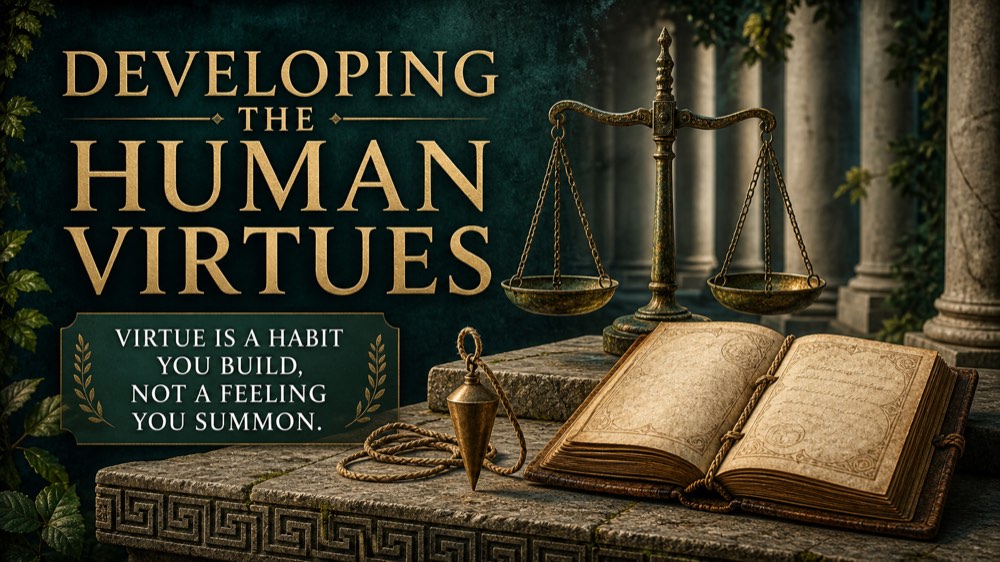
Developing the Human Virtues
BeginnerMost advice about becoming a better person is advice about trying harder, and trying harder is exactly what runs out. The classical tradition starts somewhere else: a virtue is a habitus, a stable disposition built by repeated acts, so that the good thing eventually becomes the easy thing. That is a claim about training, not about sincerity, and this course teaches it the way it was actually handed down — Aristotle systematised it, Aquinas took it up and added three virtues he held could not be drilled at all. The frame is Christian and classical, and the course says so in episode one rather than smuggling it in; the four cardinal virtues work as a description of human excellence whether or not you share the rest. You begin with the machinery. What a habit is and why a single good act is not yet a virtue. The mean between deficiency and excess, which is relative to the person and the situation and is not a recommendation of mildness — some acts admit no mean at all. The difference between a virtue and a good mood, and between vice and a bad day. Then the four cardinal virtues, two at a time, grouped by what they order. Prudence and justice face outward: prudence is the practical wisdom that decides well in the case in front of you, the virtue that tells you which rule applies when two rules collide, and justice is the settled will to give each person what is owed — in contracts, in wages, in reputation, in the ordinary honesty of returning what you borrowed. Fortitude and temperance face inward: fortitude is what keeps you at a hard thing, and the tradition insists its harder half is endurance rather than attack, while temperance is measure in pleasure — food, drink, money, screens, sex — and is a matter of proportion, not of contempt for the body. The fourth track is the part a purely secular course leaves out. Faith, hope and charity are not habits you build by repetition; the tradition calls them infused, received rather than earned, and charity is described as the form of all the other virtues, the thing that orders them toward their end. The course reports that claim as the tradition's claim and explains what it would mean if true. The last track is the method: a daily examination that takes three minutes and not thirty, the discipline of working on one virtue at a time instead of all of them, what the capital vices actually are and why they are called capital, how to read a relapse without either excusing it or despairing over it, and how to tell progress from the feeling of progress. What the course does not do: it does not moralise at you, it does not hold up any living person as an example, and it never offers virtue training as treatment for a medical or psychological condition.
Course content
Certification Exam
Certification Exam
Developing the Human Virtues
🔒 Unlock the exam
Complete the requirements above to unlock the exam
Certification Exam
Developing the Human Virtues
30 Questions
All difficulty levels
45 Minutes
Auto-submits when time expires
70% to Pass
Earn your certification badge
No Going Back
Once you answer, you move forward
Tips
See allA relapse is data, not a verdict, and the tradition reads it that way on purpose
Since virtue is built by falling less often, not by never falling, a single s...
"Capital" vice does not mean the worst vice — it means the one that heads a family of others
The tradition ranks pride or acedia as capital because other faults branch fr...
Working on one fault at a time, with an actual count, beats a general resolve to "be better"
The particular examen names a single fault and tracks its frequency, because ...
A three-minute daily examination beats a thirty-minute one that never happens
The tradition prizes a short, consistent review of the day over an ambitious ...