

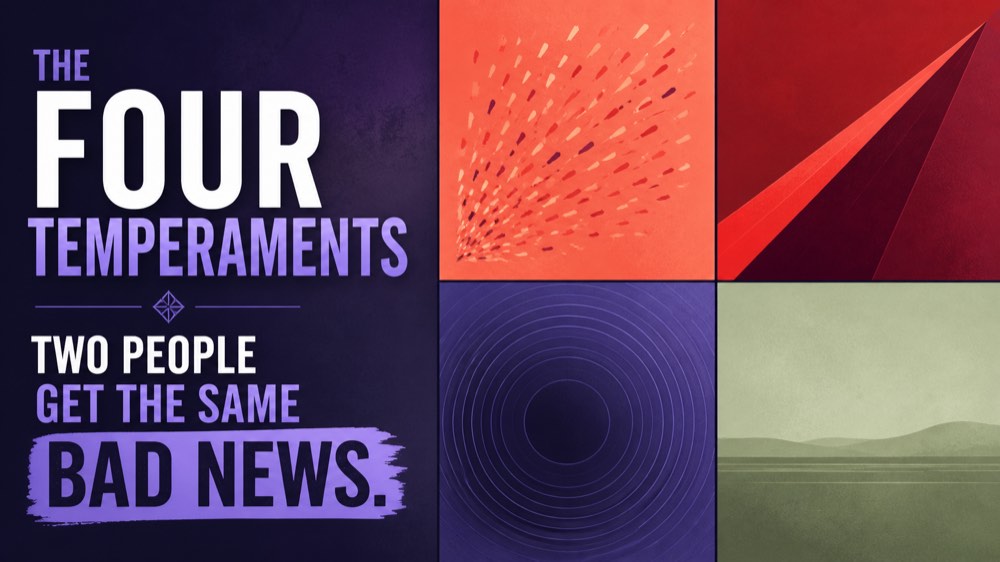
The Four Temperaments
BeginnerTwo people get the same bad news. One is talking about it within seconds and has moved on by dinner; the other says almost nothing and is still turning it over a week later. Neither is being difficult. The classical tradition has a name for that difference — temperament — and a way of sorting it that has been in use for two thousand years. This course teaches that scheme honestly, which means starting with what it is not. Temperament theory comes from Hippocrates and Galen, it was carried forward by Christian formation writers, and the physiology underneath it — four bodily humours, blood and yellow bile and black bile and phlegm — is false as medicine and has been known to be false for a long time. It is not validated modern psychology; researchers today use trait models such as the Big Five. What survives, and the reason the scheme is still worth an evening, is the observation it encodes: people differ reliably in how fast they react and in how long an impression stays with them. Those two axes give four combinations, and those four are the temperaments. The sanguine reacts fast and forgets fast. The choleric reacts fast and holds on. The melancholic is slow to react and holds on for a very long time. The phlegmatic is slow to react and lets go easily. Each gets a track: one episode drawing the portrait — how the type shows up in a meeting, in an argument, in a friendship, under a deadline — and one episode on the hard part, the characteristic blind spot, the vice that grows there naturally, the virtue that corrects it, and how to work alongside someone wired the other way. Four things the course refuses to do. It will not rank the types; there is no best temperament and every one of them reaches every virtue by a different road. It will not treat temperament as destiny; it is the raw material, and character is what you build on it, which is why a temperament excuses nothing. It will not hand you a label to pin on your spouse, your child or your colleague — this is a tool for reading yourself. And it will not let a portrait pass for a diagnosis: melancholic is not depression, choleric is not an anger disorder, phlegmatic is not laziness, and persistent low mood or uncontrolled anger is a matter for a doctor, not for a typology. Companion course: Developing the Human Virtues, which takes up where this one stops.
Course content









Certification Exam
Certification Exam
The Four Temperaments
🔒 Unlock the exam
Complete the requirements above to unlock the exam
Certification Exam
The Four Temperaments
30 Questions
All difficulty levels
45 Minutes
Auto-submits when time expires
70% to Pass
Earn your certification badge
No Going Back
Once you answer, you move forward
Tips
See allFortitude's active half and plain diligence correct the phlegmatic temperament, and neither one is a personality transplant
The corrections answer avoidance and under-asking directly, and persistent ex...
Peace and avoidance can look identical from the outside, and only one of them is a virtue
Sloth and a habit of asking for less than is owed are the phlegmatic's charac...
The phlegmatic's characteristic failure is what did not happen, not what went wrong
Omission, not commission, is where this temperament actually struggles, and i...
The phlegmatic shares the melancholic's slow start and none of its long memory
Reliability, an even temper and a genuine talent for mediation are what a rea...