

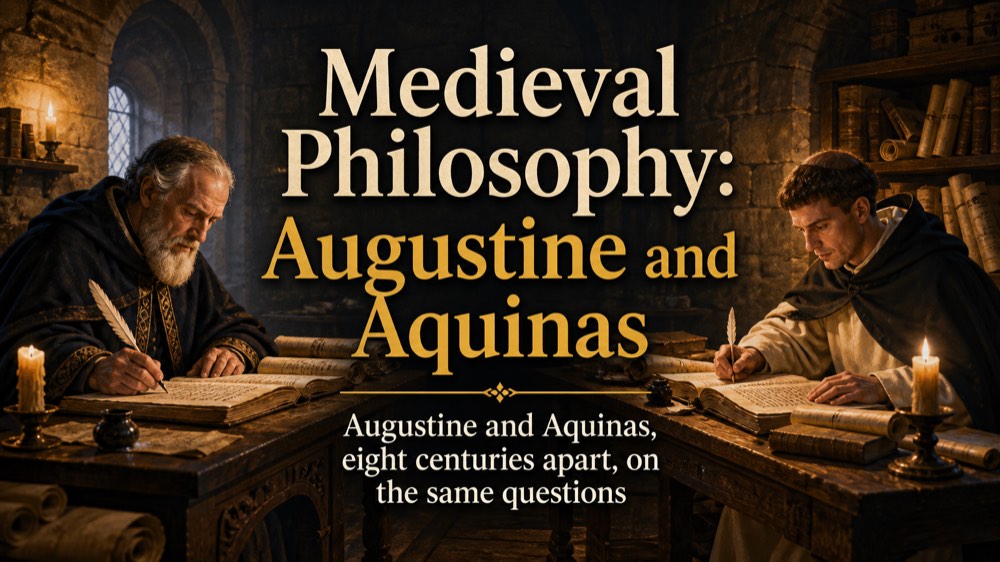
Medieval Philosophy: Augustine and Aquinas
BeginnerEight hundred years separate them, and almost every argument the West would later have about God, freedom, evil, law and the limits of reason passes through one or both. Augustine wrote as the Roman world came apart; Thomas Aquinas wrote inside an institution that had not existed in Augustine's lifetime, the university. This course reads them side by side, as two answers to overlapping questions rather than one continuous doctrine, and it is explicit about where they part company. You begin with the two worlds: a North African bishop who spent nine years as a Manichee and wrote the first autobiography the West would recognise as one, and a Dominican friar in Paris and Naples working through a flood of newly translated Aristotle that reached Latin readers largely through Arabic and Jewish philosophers — al-Farabi, Avicenna, Averroes, Maimonides — whom Aquinas cites by name, including where he rejects them. Then faith and reason, the question the course keeps returning to. Augustine's formula is crede ut intelligas, believe so that you may understand, with a theory of divine illumination behind it; Aquinas draws a working boundary instead, separating what reason can reach on its own from what it cannot, and calling the first group the preambles of faith. Track three takes the arguments for God seriously enough to state them properly: Augustine's inward route through truth itself in On Free Choice of the Will, and then the Five Ways of Summa Theologiae I, question 2, article 3 — each one, in order, with the two misreadings that ruin them corrected. Motion in the First Way means change, not movement through space, and the causal series in the first two Ways is ordered here and now, not backwards through history: Aquinas held that reason alone cannot show the universe had a beginning. Hume, Kant and Russell are named where they object. Track four is the problem of evil: the Manichee answer Augustine abandoned, evil as privation rather than a thing, free choice as the cost of a good that could not exist without it, the long argument with Pelagius over grace, and what Aquinas kept and changed. The last track is the inheritance — the two cities, the invention of interiority, natural law and the vocabulary of rights, why a condemnation in 1277 caught up propositions associated with a man canonised in 1323, and how to read either thinker without a course.
Course content




Certification Exam
Certification Exam
Medieval Philosophy: Augustine and Aquinas
🔒 Unlock the exam
Complete the requirements above to unlock the exam
Certification Exam
Medieval Philosophy: Augustine and Aquinas
30 Questions
All difficulty levels
45 Minutes
Auto-submits when time expires
70% to Pass
Earn your certification badge
No Going Back
Once you answer, you move forward
Tips
See allAn unjust law is a corruption of law, not law in the fullest sense — and that claim costs something
Aquinas ties law's authority to reason ordered to the common good, which make...
Reading a Summa article means reading the objections as the strongest case first
The quaestio format states the other side before Aquinas states his own, and ...
What then is time? Augustine's question in Confessions XI has not gone away
He locates past and future in a present mind, through memory and expectation,...
The two cities are not two institutions you could visit
Augustine's City of God and earthly city are defined by what people love, and...