

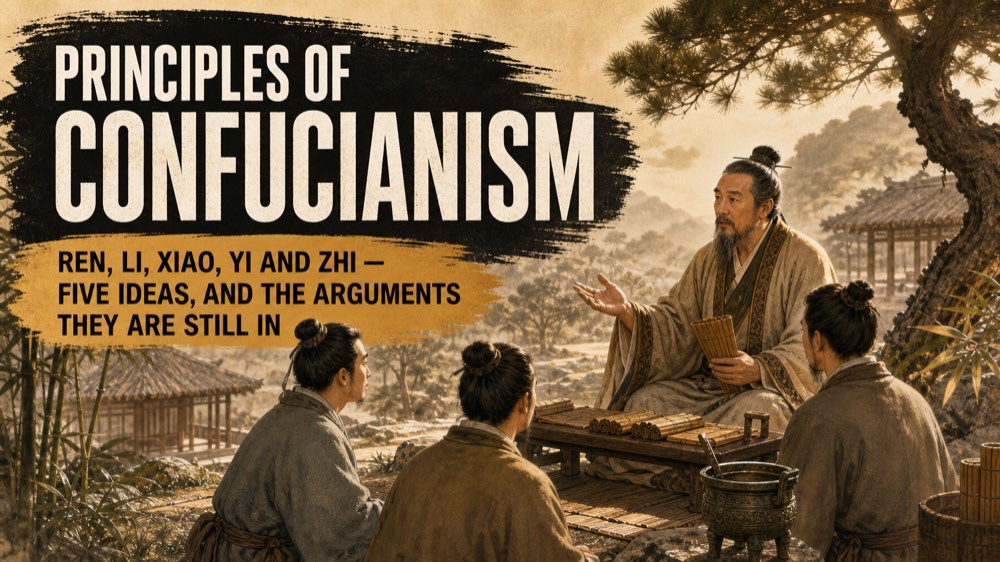
Principles of Confucianism
BeginnerKong Qiu, known in the West by the Latinised name the Jesuits gave him — Confucius — lived 551 to 479 BCE in the state of Lu, during the Spring and Autumn period, when the Zhou king's authority had collapsed into rival courts. He held minor offices, gathered students, and left nothing in his own hand: the Analects (Lunyu), the text this course keeps returning to, was assembled by his disciples and their disciples across generations after his death, so every line is reported as 'the Analects records' or 'attributed to Confucius,' never as something he wrote. Whether the result is a religion is a live scholarly dispute, not a question this course settles: the tradition kept ritual and the veneration of ancestors without a creator god or a theistic clergy, and historians of religion divide over what to call that. The course follows four ideas the Analects circles back to — ren 仁, the humane bond between people; li 禮, the ritual and decorum that hold a household or a state together; xiao 孝, the devotion owed to parents and ancestors; and yi 義 paired with zhi 智, doing right without calculating advantage and the judgment to tell the difference — along with junzi 君子, the exemplary person the tradition holds up as a model, and shu 恕, the reciprocity behind Analects 15.24, 'do not impose on others what you do not desire': a silver rule, negative in form, never merged with the Christian Golden Rule. It reports where the tradition argues with itself: Mencius (Mengzi, c. 372-289 BCE) held that human nature tends toward good; Xunzi (c. 310-235 BCE) held that it needs deliberate shaping; centuries later Zhu Xi (1130-1200) and Wang Yangming (1472-1529) rebuilt the school again as Neo-Confucianism, on terms Confucius never used. It follows the tradition into government: adoption under Emperor Wu of Han with the scholar Dong Zhongshu in the second century BCE, the civil service examinations (keju 科舉) built on the Four Books and Five Classics that ran from the Sui and Tang dynasties until their abolition in 1905. It follows the tradition west: the Jesuit Matteo Ricci and his colleagues, the Latinised name first printed in 1687, Leibniz and Voltaire citing China in Enlightenment arguments, and the dismissal that followed in the nineteenth century from Hegel and later Max Weber. And it follows the twentieth century as contested rather than settled: the May Fourth attack on Confucius in 1919, the Criticise Lin, Criticise Confucius campaign of 1973-76, the revival after the 1980s, the Confucius Institutes opened from 2004, and the disputed thesis that Confucian culture explains East Asian economic growth. Xiao gets no soft treatment: the Analects and the Classic of Filial Piety require a child to remonstrate with a parent in the wrong, and the course states the costs the tradition's own critics and outsiders have named — rigid hierarchy, the subordination of women, the Three Obediences. No ancient wisdom, no mysticism, no instruction to believe: only what Confucians argued, and why others disagreed.
Course content

Certification Exam
Certification Exam
Principles of Confucianism
🔒 Unlock the exam
Complete the requirements above to unlock the exam
Certification Exam
Principles of Confucianism
30 Questions
All difficulty levels
45 Minutes
Auto-submits when time expires
70% to Pass
Earn your certification badge
No Going Back
Once you answer, you move forward
Tips
See allConfucius wrote not a single line of the Analects
The text was assembled by generations of disciples after his death, and that ...
Analects 15.24 gives a Silver Rule, not the Golden Rule
"Do not impose on others what you do not desire" is negative in form, and the...
"Confucius" is a 1687 Jesuit invention, not a Chinese name
The Latin form was coined by missionaries building a case for China in Rome, ...
Mencius and Xunzi flatly disagree about human nature — inside the same tradition
One says people are born good; the other says goodness has to be built, and b...