

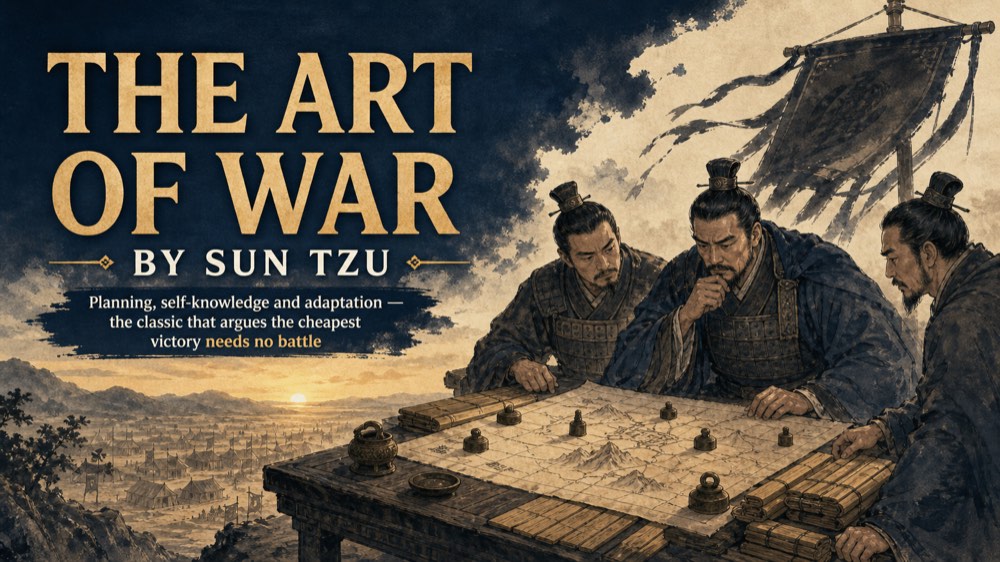
The Art of War by Sun Tzu
BeginnerSunzi 孫子 — the honorific behind the familiar Wade-Giles spelling "Sun Tzu" this course keeps in its title because that is how learners search for it — is traditionally dated to the late sixth century BCE, a general said to have served the southern state of Wu during the chaos of the Spring and Autumn period. The tradition names him Sun Wu; whether he was one historical man is genuinely disputed, and much of the scholarship behind this course treats the received Bingfa 兵法 (Military Methods, the text's own name, usually rendered The Art of War) as a product of the later Warring States period, compiled and revised across generations rather than set down whole by a single hand at a single sitting. In 1972, excavators at Yinqueshan in Shandong opened a Han-dynasty tomb and found bamboo slips carrying a second-century-BCE copy of the Bingfa alongside a separate, previously lost text, the Sun Bin Bingfa — the military methods of Sun Bin, a strategist active a century or more later and a different author entirely. The find proved the two works are distinct; it did not settle who Sun Wu was or whether he existed as described. What survives is thirteen chapters (pian), and this course names them when it quotes from them, because which chapter a line comes from changes what it can support. It also names whose English it is quoting, because the choice matters: Lionel Giles' 1910 translation is the public-domain version everyone encounters first online, and also the most dated in its English; Samuel B. Griffith's 1963 translation reads as a soldier's; Roger T. Ames' 1993 edition foregrounds the philosophical vocabulary; Victor Mair's 2007 translation works closest to recent textual scholarship. The course tracks two lines closely because both get mangled in circulation. Chapter 3's most quoted sentence promises that knowing the other side and knowing yourself means you will not be in peril in a hundred battles — not victory in a hundred battles, a stronger claim the text does not make. And "breaking the enemy's resistance without fighting is the acme of skill," also chapter 3, is an argument about the cost of prolonged war, not a pacifist creed; Sunzi assumes war happens and reasons about how to make it short and affordable, not about whether to avoid it. Chapter 1's claim that "war is based on deception" is a claim about war, which the course keeps distinct from any instruction to deceive a colleague. From the 1980s and 1990s, the Bingfa was widely read outside its own subject as a management, finance, and sports-coaching text; the course reports that reception together with the critics who answer that reading it as a book about work licenses treating colleagues and customers like enemies, without taking either side. It also reports, with its source and its violence intact, the anecdote in Sima Qian's Shiji — written around 100 BCE, four centuries after Sunzi's supposed lifetime — of a demonstration on the king of Wu's palace women that ends with two of his favourites executed. Clausewitz appears as a comparison, not a rival to declare inferior or superior. Every track closes by testing the text's ideas against ordinary conflict and competition today, offered as analogy, never as something the Bingfa itself claims about a modern workplace.
Course content
Certification Exam
Certification Exam
The Art of War by Sun Tzu
🔒 Unlock the exam
Complete the requirements above to unlock the exam
Certification Exam
The Art of War by Sun Tzu
30 Questions
All difficulty levels
45 Minutes
Auto-submits when time expires
70% to Pass
Earn your certification badge
No Going Back
Once you answer, you move forward
Tips
See allThe book's most quoted line promises safety, not victory
Chapter 3 says you will not be in peril in a hundred battles — never that you...
"Sun Tzu" may name a tradition, not a single man
The historicity dispute is real enough that "traditionally attributed" is the...
The 1972 bamboo find proved two books, not one man
Yinqueshan settled that Sunzi and Sun Bin wrote separate texts — not who Sun ...
Which translator you read decides what the book seems to argue
Giles 1910, Griffith 1963, Ames 1993 and Mair 2007 are four different Bingfa ...