

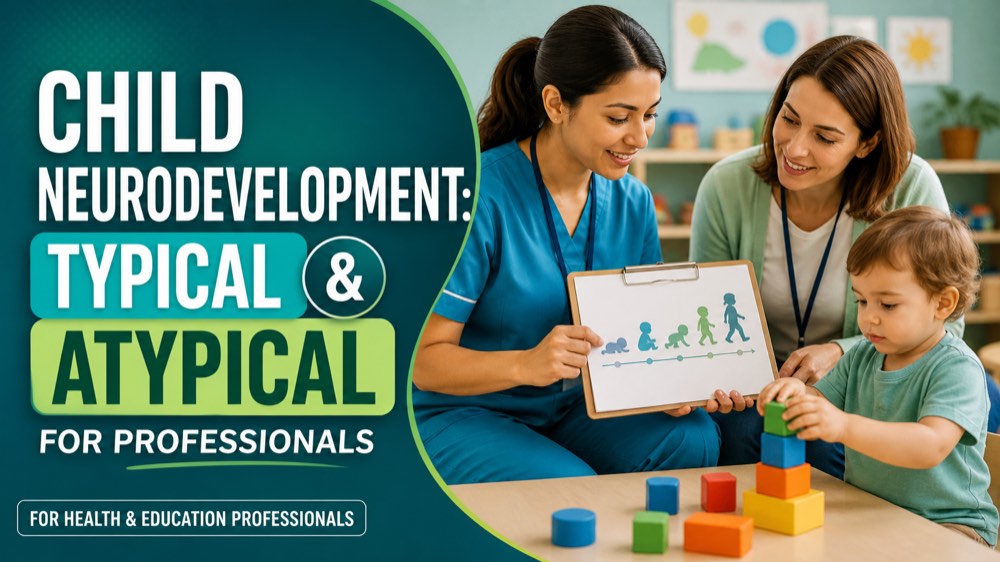
Child Neurodevelopment: Typical and Atypical for Professionals
BeginnerThe working foundation for anyone who looks after young children in a clinic, a health centre or a classroom. The course starts with the neuroscience that matters in practice — sensitive periods, risk and protective factors, prematurity, adversity and the neuromyths still taught in schools — and moves to surveillance and screening: what the M-CHAT-R/F, ASQ-3 and SWYC actually measure, why Denver II is not enough on its own, and how to use corrected age. It explains the DSM-5-TR and ICD-11 criteria for autism, ADHD, intellectual disability and learning disorders, and the differential diagnosis every professional must keep in mind, from hearing loss to deprivation and epilepsy. It then covers interventions ranked by evidence and how a team shares the work, and ends with school, family and the care network: individualised education plans, how to communicate a diagnosis, when and where to refer, ethics, and the US laws that protect the child — IDEA, Section 504 and the ADA.
Course content
Certification Exam
Certification Exam
Child Neurodevelopment: Typical and Atypical for Professionals
🔒 Unlock the exam
Complete the requirements above to unlock the exam
Certification Exam
Child Neurodevelopment: Typical and Atypical for Professionals
30 Questions
All difficulty levels
45 Minutes
Auto-submits when time expires
70% to Pass
Earn your certification badge
No Going Back
Once you answer, you move forward
Tips
See allTreat a vision or hearing doubt as urgent
Sensitive periods make timing part of the treatment
Point out one serve-and-return moment per visit
Show the caregiver what responsiveness looks like
Ask about sleep before you interpret behaviour
Poor sleep can look like inattention and irritability
Write down risk factors and raise your vigilance
A risk factor is a reason to look more often, not a diagnosis