PostgreSQL Fundamentals
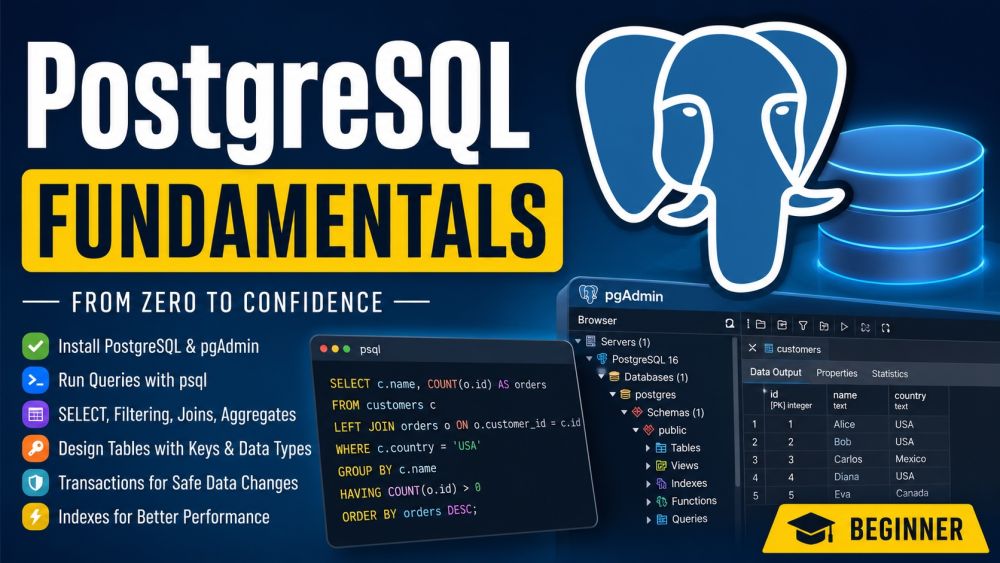
BeginnerLearn PostgreSQL from zero — the world's most advanced open-source database. Install it, run your first queries with psql and pgAdmin, and master the SQL you need every day: SELECT and filtering, joins and aggregates, designing tables with the right data types and keys, modifying data safely with transactions, and speeding things up with indexes. No prior database experience required — by the end you can build and query a real PostgreSQL database with confidence.
Videos
See allTracks
Go from nothing installed to running real SQL. Install PostgreSQL on macOS, Windows, or Linux, connect with the psql command line and the pgAdmin GUI, and create your first database. Then learn the foundation of every query: SELECT, choosing columns, filtering rows with WHERE, sorting with ORDER BY, and limiting results. By the end of this track you can connect to a database and pull exactly the data you want.
Real questions need data from more than one table. Master the JOIN family (INNER, LEFT, RIGHT, FULL) to combine related tables, summarize data with aggregate functions (COUNT, SUM, AVG, MIN, MAX) and GROUP BY, filter groups with HAVING, and answer harder questions with subqueries. This is the track that turns you from reading single tables to actually analyzing data.
Good data starts with good structure. Learn to CREATE TABLE, pick the right PostgreSQL data types (integer, text, numeric, boolean, timestamp, serial, JSONB), and enforce correctness with constraints — primary keys, foreign keys, NOT NULL, UNIQUE, CHECK, and DEFAULT. Understand how primary and foreign keys model relationships, and how to ALTER tables as your needs change. Design schemas that keep your data clean.
Reading data is only half the job. Learn to INSERT new rows, UPDATE existing ones, and DELETE safely (and why a missing WHERE is dangerous). Then make changes reliable with transactions: BEGIN, COMMIT, and ROLLBACK, the ACID guarantees that keep your data consistent, and using RETURNING and UPSERT (ON CONFLICT). Walk away able to change data without fear of breaking it.
Make your database fast and manageable. Learn how indexes work and when to add them (B-tree basics, EXPLAIN to see query plans), create reusable views, and write simple functions. Then cover the administration essentials every beginner should know: users and roles, GRANT and basic permissions, and backing up and restoring with pg_dump. Finish ready to keep a real PostgreSQL database fast, organized, and safe.
Certification Exam
Certification Exam
PostgreSQL Fundamentals
All tracks · No time pressure to start
Certification Exam
PostgreSQL Fundamentals
30 Questions
All difficulty levels
45 Minutes
Auto-submits when time expires
70% to Pass
Earn your certification badge
No Going Back
Once you answer, you move forward
Tips
See allWHERE Filters Rows, HAVING Filters Groups
Know which runs before grouping
Never Store Money as FLOAT
Use NUMERIC for exact decimals
Primary Keys Identify, Foreign Keys Connect
The backbone of relational design
Prefer GENERATED AS IDENTITY Over SERIAL
The modern standard for auto IDs