

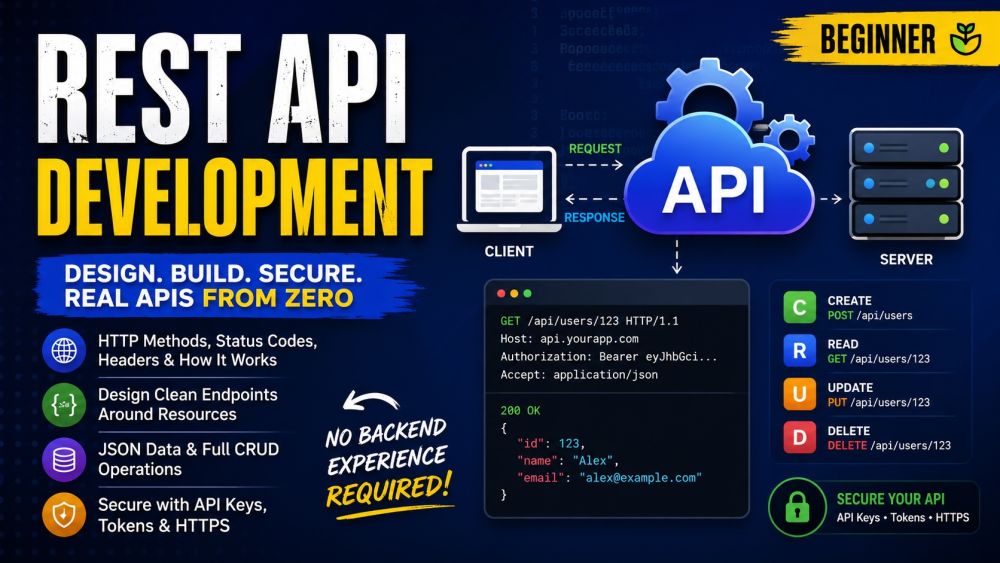
REST API Development
BeginnerLearn to design and build REST APIs from zero — the backbone of every modern app, website, and mobile product. Understand how HTTP really works (methods, status codes, headers), design clean endpoints around resources, exchange data with JSON, and build full CRUD operations that create, read, update, and delete data. Then secure your API with keys, tokens, and HTTPS. No backend experience required — by the end you can design, build, and protect a real REST API with confidence.
Videos
See allTracks
Start at the foundation every API is built on. Learn what an API actually is, how the HTTP request/response cycle works, and the meaning of methods (GET, POST, PUT, PATCH, DELETE), status codes (200, 201, 404, 500), and headers. Then understand the REST style itself: resources, statelessness, and why REST became the standard for connecting apps. By the end you can read and understand any HTTP exchange.
A good API is easy to read and predictable. Learn to model your data as resources and name endpoints well (nouns not verbs, collections vs single items), use path and query parameters correctly, and handle real-world needs: filtering, sorting, pagination, and versioning. See what separates a clean, professional API from a confusing one — and design URLs other developers love to use.
APIs exchange data, and on the web that data is almost always JSON. Master JSON syntax (objects, arrays, types), how request and response bodies work, and the role of the Content-Type header. Learn to validate incoming data, shape consistent responses, and return clear, useful error messages when something goes wrong. By the end you can confidently move structured data in and out of an API.
CRUD is the heart of almost every API. Learn how the four basic operations — Create, Read, Update, Delete — map onto HTTP methods (POST, GET, PUT/PATCH, DELETE) and the right status code to return for each. Build endpoints that add new records, fetch single items and lists, update existing data, and delete safely. Understand idempotency and PUT vs PATCH so your API behaves correctly every time.
An open API is a risk. Learn the essentials of protecting one: the difference between authentication and authorization, securing requests with API keys and Bearer tokens (a first look at JWT), and why HTTPS is non-negotiable. Then cover the everyday defenses every API needs — rate limiting, CORS, and avoiding common mistakes that leak data. Finish able to ship an API that is safe for real users.
Certification Exam
Certification Exam
REST API Development
All tracks · No time pressure to start
Certification Exam
REST API Development
30 Questions
All difficulty levels
45 Minutes
Auto-submits when time expires
70% to Pass
Earn your certification badge
No Going Back
Once you answer, you move forward
Tips
See allLet HTTP Methods Carry the Verb
The method says what to do, the URL says where
Status Codes Come in Families
The first digit tells you the whole story
REST Servers Have No Memory
Every request must stand on its own
Idempotent Means Safe to Retry
Same request, same result, every time