
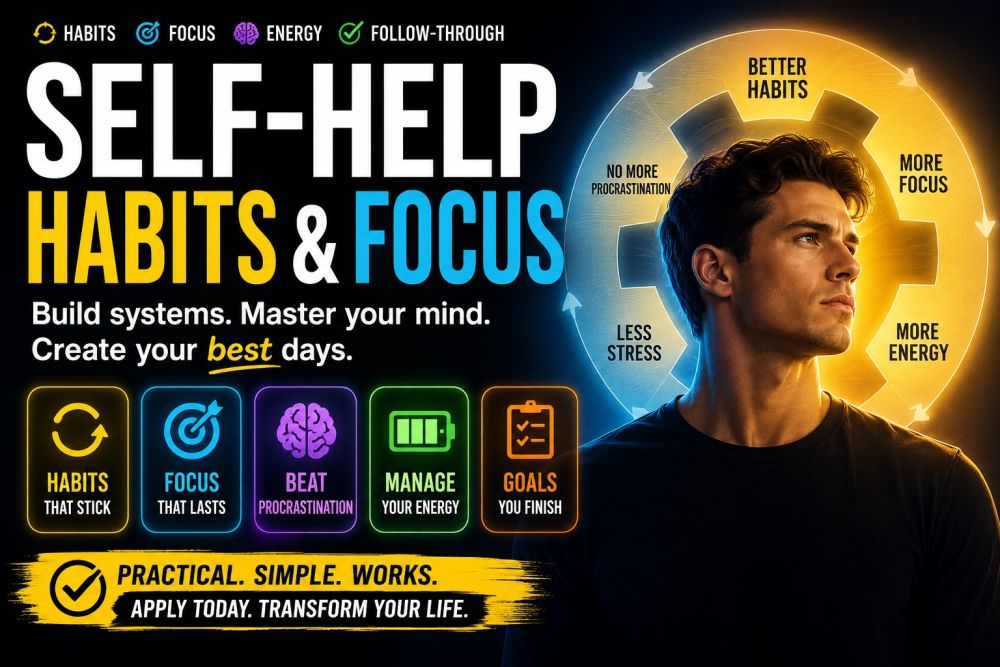
Self-Help: Habits & Focus
BeginnerStop relying on motivation and start building systems that run themselves. This beginner course is a practical, no-fluff guide to the skills that quietly decide how your days go: habits, focus, procrastination, energy, and follow-through. You will learn how habits actually form — the cue, routine, and reward loop — and how to design tiny, repeatable behaviors that survive busy weeks and bad moods. From there you will protect your attention in a world built to steal it, master deep work, and understand procrastination as an emotion-management problem rather than a willpower flaw. You will learn to manage energy instead of just time, recover from stress and setbacks, and bounce back without burning out. Finally, you will set goals you actually finish by turning vague intentions into clear next actions and review loops. Every lesson is something you can apply today, no theory for its own sake.
Videos
See allTracks
Motivation fades, but a well-built habit keeps running on autopilot. Start here: learn the cue-routine-reward loop that drives every habit, and why your brain craves the reward more than the behavior itself. You will make new habits obvious and easy by shrinking them down, attaching them to things you already do, and shaping the environment so the right choice is the default. You will also learn to break bad habits by adding friction and removing triggers. By the end you can design a small daily habit that survives busy weeks, missed days, and bad moods — without relying on willpower.
Your attention is your most valuable and most stolen resource. This track teaches you to defend it. Learn the real cost of multitasking and context switching, and why every interruption costs far more than the minute it takes. You will set up deep work sessions with clear blocks of uninterrupted time, design a workspace and notification setup that removes temptation before it starts, and use simple techniques like timeboxing and the Pomodoro method to stay in flow. You will also learn to manage digital distraction at its source. By the end you can reliably enter and protect a state of focused, high-quality work.
Procrastination is not laziness — it is how we avoid the uncomfortable feelings a task brings up. This track reframes the problem so you can actually solve it. Learn why you delay: the dread, perfectionism, ambiguity, and short-term mood repair that hijack your good intentions. Then break the loop with practical moves — shrink the task until starting feels trivial, use the two-minute rule and the five-minute start to beat the activation barrier, and make the next action so concrete there is nothing left to decide. You will also learn to forgive past procrastination, which research shows reduces future avoidance. By the end you can get moving on the things you have been putting off.
Time management fails when you are exhausted — the real game is managing energy. This track shows you how. Learn that energy is physical, emotional, and mental, and that it runs in cycles you can work with instead of against. You will match your hardest work to your natural peaks, take real recovery breaks instead of fake ones, and protect the sleep, movement, and downtime that refill the tank. Then build resilience: understand stress and burnout as signals, not failures, and learn to bounce back from setbacks with self-compassion rather than self-criticism. By the end you can sustain effort over the long haul without grinding yourself down.
Most goals fail not because they are too hard, but because they stay vague. This track turns intentions into finished outcomes. Learn why focusing on systems and identity beats chasing outcomes alone, and how to translate a big goal into a clear next action you can take today. You will use implementation intentions — if-then plans that decide in advance when and where you will act — and habit stacking to anchor new behaviors. Then you will track progress in a way that keeps you honest, run a simple weekly review to catch drift early, and adjust without quitting. By the end you can take a goal from a fuzzy wish to something you reliably follow through on.
Certification Exam
Certification Exam
Self-Help: Habits & Focus
All tracks · No time pressure to start
Certification Exam
Self-Help: Habits & Focus
30 Questions
All difficulty levels
45 Minutes
Auto-submits when time expires
70% to Pass
Earn your certification badge
No Going Back
Once you answer, you move forward
Tips
See allBuild systems, not just goals
The daily process is what carries you
Time block your priorities
A to-do list without a slot rarely happens
Manage energy, not just time
Match hard work to your peak hours
Protect your sleep first
Rest is the base every habit stands on