WBF Academy
Financial Education

Financial Education

Beginner

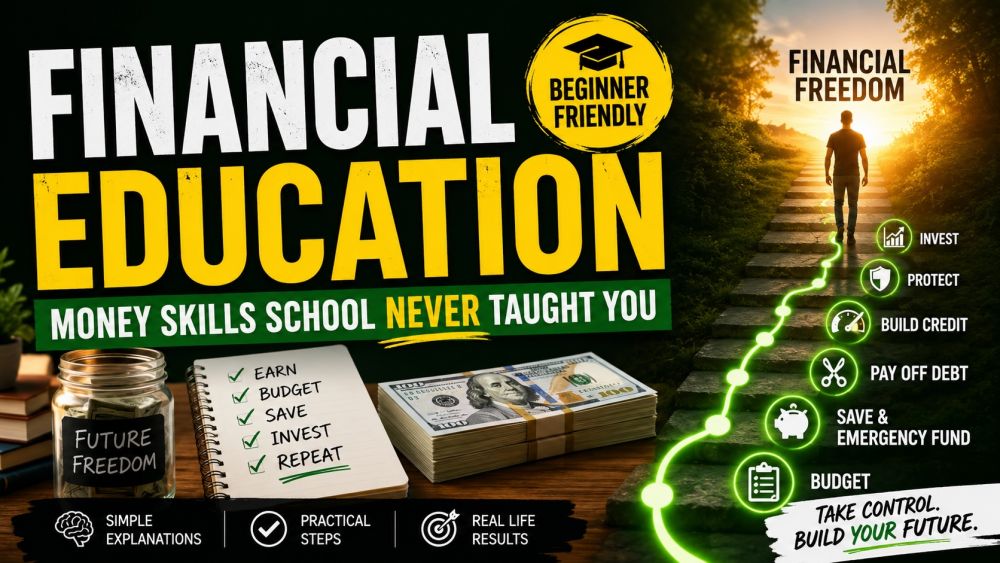
Money runs through every part of life, yet almost no one is taught how to handle it. This beginner course gives you the practical money skills school skipped — no jargon, no finance degree required. You will start by understanding your income: gross versus net pay, taxes, and how to turn earnings into a plan instead of a guess. From there you will build a budget that actually holds up using simple methods like 50/30/20, learn to tell needs from wants, and stop the silent leaks that drain a paycheck. You will set up an emergency fund and saving habits that work on autopilot, then tackle debt head-on — how interest really works, which debts to kill first, and how to build and protect a strong credit score. Finally you will take your first confident steps as an investor: compound growth, risk, diversification, and why starting early beats starting big. By the end you will manage your money with a plan and a calm head instead of stress and guesswork.

📋 5 tracks ❓ 150 questions 💡 15 tips 🎬 3 videos ⏱ ~3h

Videos

See all

Tracks

Everything in personal finance starts with income — but most people never look closely at theirs. Learn the difference between gross and net pay, what those deductions on your payslip actually are, and how taxes work at a basic level. You will see how salaried, hourly, freelance, and side-income are treated differently, why your take-home is the number that matters for budgeting, and how raises and bonuses really land after tax. You will also learn to think about growing income over time — skills, negotiation, and extra streams — so your money plan is built on a clear picture of what is truly coming in.

A budget is not about restriction — it is about telling your money where to go before it disappears. Learn simple, proven methods like the 50/30/20 split and zero-based budgeting, and how to choose the one that fits your life. You will learn to separate true needs from wants without guilt, track spending in a way you will actually keep up, and spot the silent leaks — subscriptions, impulse buys, fees — that quietly drain a paycheck. You will also pick up smart-spending habits: comparing real cost, avoiding lifestyle creep when income rises, and planning for irregular bills so they never blindside you. By the end you can run your month with a plan instead of hoping the money lasts.

Saving is what turns a budget into security. Start with the most important account you can have — an emergency fund — and learn how big it should be, where to keep it, and why it stops one bad month from becoming a debt spiral. You will learn to automate saving so it happens before you can spend the money, set clear goals with deadlines, and use the right kind of account for short-term versus long-term cash. The track also covers pay-yourself-first thinking, sinking funds for known future costs, and the difference between saving and investing so you always keep the money you will need soon somewhere safe. By the end you will have a real cushion and the habit that keeps it growing.

Debt and credit are where money plans are won or lost. Learn how interest really works — the difference between APR, compounding, and the minimum-payment trap that keeps balances alive for years. You will compare the two proven payoff strategies, avalanche and snowball, and learn which debts to attack first. The track then demystifies credit: what a credit score is, the handful of things that actually move it, and how to build and protect a strong one. You will learn the smart way to use a credit card, what to do about collections, and how to tell good debt from bad. By the end you will have a clear plan to get out of debt and a credit profile that works for you, not against you.

Once your budget holds and your emergency fund is set, investing is how money grows while you sleep. Learn the single most powerful idea in finance — compound growth — and why starting early beats starting big. You will understand the basic building blocks: stocks, bonds, index funds, and why diversification lowers risk without lowering your odds. The track explains risk versus return in plain language, the long game of retirement accounts, and why time in the market beats timing the market. You will also learn to spot fees that quietly eat returns, avoid get-rich-quick traps, and take a sensible first step as a brand-new investor. By the end you will understand how everyday people build real wealth over time.

Certification Exam

🏆

Certification Exam

Financial Education

30
Questions
45m
Time Limit
% 70%
To Pass

All tracks · No time pressure to start

🏆

Certification Exam

Financial Education

#

30 Questions

All difficulty levels

45 Minutes

Auto-submits when time expires

%

70% to Pass

Earn your certification badge

No Going Back

Once you answer, you move forward

Tips

See all