
WBF Academy
Critical Thinking & Problem Solving

Critical Thinking & Problem Solving

Beginner

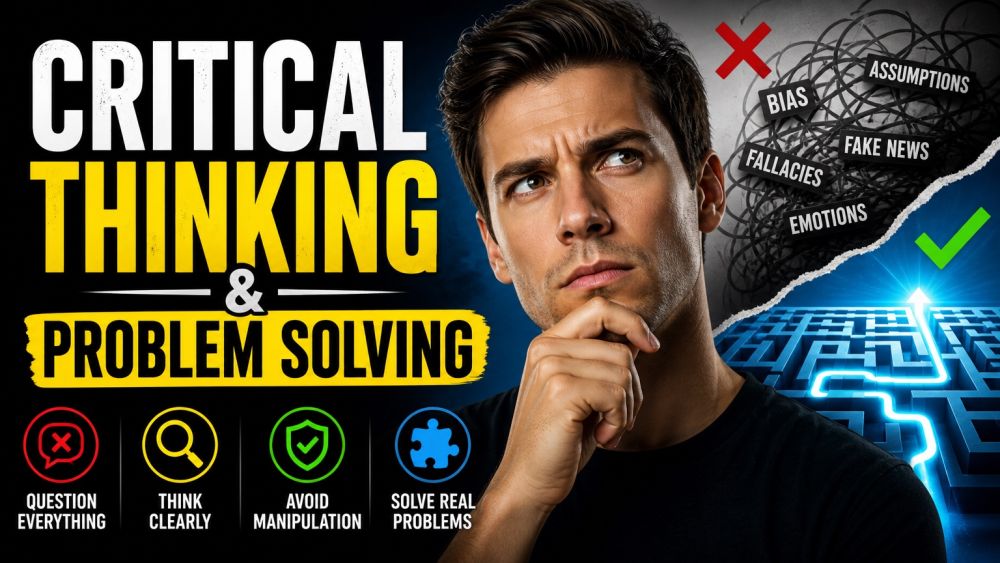
We make hundreds of decisions a day, yet almost no one is taught how to think well — how to reason clearly, spot a weak argument, resist manipulation, and solve problems without guessing. This beginner course gives you those tools in plain language, with everyday examples you will recognize instantly. You will start with the foundations of reasoning: claims, evidence, logic, and how to tell a strong argument from a persuasive but empty one. Then you will meet your own mind's shortcuts — the cognitive biases like confirmation bias and anchoring that quietly distort your judgment — and learn practical ways to catch them. From there you pick up thinking frameworks and mental models that make hard questions tractable, from first principles to weighing trade-offs. You will learn a repeatable process for making better decisions under uncertainty, and finish with a structured approach to solving real problems: define, diagnose, generate options, and choose. Nothing here is academic for its own sake — every lesson sharpens how you think at work and in life. By the end you will question smarter, get fooled less, and solve problems with a clear head.

📋 5 tracks ❓ 250 questions 💡 20 tips 🎬 10 videos ⏱ ~5h

Videos

See all

Tracks

Clear thinking starts with understanding how arguments actually work. This track teaches you the building blocks of reasoning: the difference between a claim and the evidence for it, how premises lead to conclusions, and how to tell a strong argument from one that just sounds good. You will learn deductive versus inductive reasoning in plain terms, how to spot unstated assumptions, and the most common logical fallacies that fool smart people every day. We keep it practical with examples from ads, news, and everyday debates. By the end you will dismantle a weak argument and build a solid one of your own.

Your brain runs on shortcuts that are fast but often wrong, and these biases quietly steer your judgment without you noticing. This track introduces the most important ones in everyday language: confirmation bias, anchoring, availability, sunk cost, the halo effect, and more. You will see exactly how each one shows up in real decisions — shopping, hiring, arguments, money — and why even experts fall for them. More importantly, you will learn concrete habits to catch and counter them, like seeking disconfirming evidence and slowing down on high-stakes calls. By the end you will recognize your own biases in the moment and think around them.

Good thinkers do not start from scratch every time — they reach for frameworks that structure a messy problem. This track hands you a toolkit of practical mental models and shows when to use each. You will learn first-principles thinking to break a problem to its basics, second-order thinking to see consequences of consequences, and inversion to solve by avoiding failure. We cover cost-benefit and trade-off analysis, the map-versus-territory idea, and simple tools like pros-and-cons done right and the 80/20 rule. Each model comes with a concrete example so it sticks. By the end you will match the right framework to the problem in front of you.

Most decisions are made on gut and hope, then rationalized later. This track gives you a calmer, repeatable process for choosing well when the answer is not obvious. You will learn to separate the decision from the outcome, define your real goal and criteria upfront, and weigh options without drowning in analysis. We cover expected value in plain terms, how to think in probabilities instead of certainties, when to decide fast versus slow, and how to avoid classic traps like sunk cost and analysis paralysis. You will also learn to make reversible bets and to keep a simple decision journal. By the end you will decide with structure and confidence.

The final track turns everything into a hands-on method for cracking real problems. You will learn a simple, repeatable loop: define the problem precisely, diagnose the root cause instead of the symptom, generate several options, and choose deliberately. We cover powerful tools like asking "why" five times, breaking big problems into smaller parts, questioning your assumptions, and testing a solution cheaply before betting everything. You will also learn to avoid solving the wrong problem well — the most common and costly mistake. Every step uses everyday examples from work and home. By the end you will approach any stuck situation with a calm, structured plan instead of panic.

Certification Exam

🏆

Certification Exam

Critical Thinking & Problem Solving

30
Questions
45m
Time Limit
% 70%
To Pass

All tracks · No time pressure to start

🏆

Certification Exam

Critical Thinking & Problem Solving

#

30 Questions

All difficulty levels

45 Minutes

Auto-submits when time expires

%

70% to Pass

Earn your certification badge

No Going Back

Once you answer, you move forward

Tips

See all