
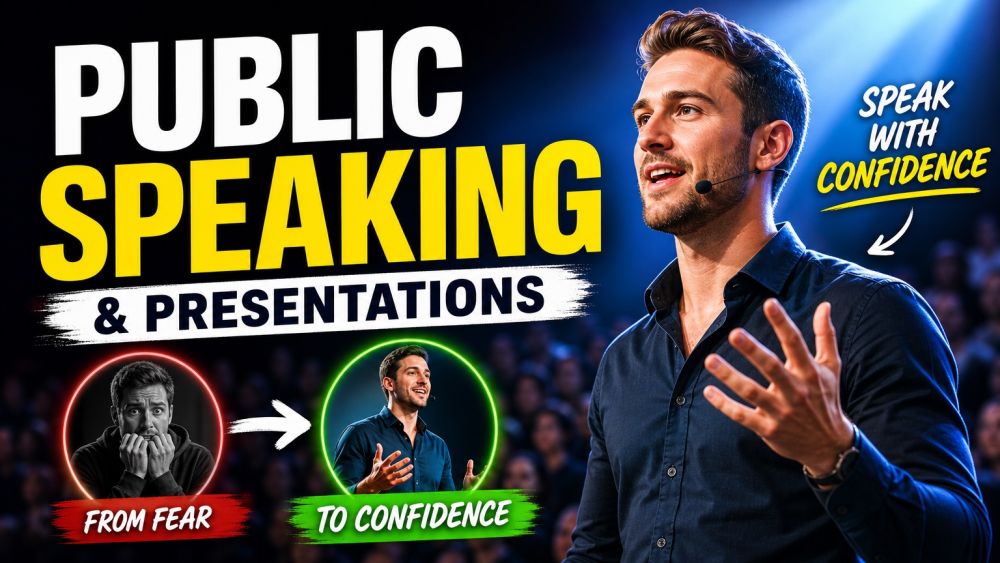
Public Speaking & Presentations
BeginnerThe fear of speaking in public is almost universal — and almost entirely fixable. This beginner course turns that dread into a skill you can rely on, whether you are pitching an idea, leading a meeting, or giving a talk. You will start by taming the nerves: understanding why your body reacts the way it does and using simple, proven techniques to steady yourself before and during a talk. Then you will learn to structure a message so it lands — a strong opening, a clear through-line, and an ending people remember. From there we work on delivery: your voice, pace, pauses, body language, and eye contact, so you sound confident and natural instead of stiff. You will learn to build slides that support you rather than upstage you, and finally how to own the room — handling questions, recovering from mistakes, and connecting with any audience. Every lesson is practical, with exercises you can rehearse today. By the end you will walk up to speak with a plan, a steady voice, and the quiet confidence that you have got this.
Videos
See allTracks
Almost everyone feels fear before speaking — the goal is not to erase it but to master it. This track explains why your heart races and your voice shakes, then hands you simple, proven tools to steady yourself: breathing that resets your nervous system, preparation that builds real confidence, and reframes that turn adrenaline into presence. You will learn what to do in the tense minutes before you start and how to recover if nerves spike mid-talk. By the end fear becomes a signal you can work with, not a wall that stops you.
A talk lives or dies on its structure. This track gives you a reliable shape for any presentation: a hook that earns attention in the first ten seconds, a single clear message everything supports, and a close that people carry out the door. You will learn to cut ruthlessly, use stories and examples that stick, and build smooth transitions so your ideas flow. Whether it is a two-minute update or a keynote, you will learn to organize your thoughts so the audience never gets lost. By the end you will outline a clear, persuasive talk fast.
Your words are only half the message; how you deliver them is the rest. This track trains the mechanics of a confident presence: using your voice with pace, volume, and pauses that hold attention, standing and moving with purpose, and making real eye contact instead of scanning the floor. You will learn to slow down, to let silence work for you, and to use gestures that reinforce rather than distract. We also fix the common habits — filler words, pacing, monotone. By the end you will deliver your message so it sounds as good as it reads.
Most slides hurt the talk instead of helping it. This track teaches you to build visuals that support your message: one idea per slide, few words, big readable type, and images that add meaning instead of decoration. You will learn why bullet-point walls lose the room, how to use contrast and simple charts, and when the best slide is no slide at all. We cover practical rules for text size, color, and consistency. By the end your slides will guide the audience and free you to be the presenter they actually watch.
The final skill is presence under pressure — being at ease no matter what the room throws at you. This track prepares you for the live moments: fielding tough questions without panic, recovering smoothly when something goes wrong, reading the audience and adjusting, and connecting so people feel spoken to, not spoken at. You will learn to handle silence, hecklers, tech failures, and nerves that return. We finish with how to close strong and leave a lasting impression. By the end you will speak like someone who belongs at the front of the room.
Certification Exam
Certification Exam
Public Speaking & Presentations
All tracks · No time pressure to start
Certification Exam
Public Speaking & Presentations
30 Questions
All difficulty levels
45 Minutes
Auto-submits when time expires
70% to Pass
Earn your certification badge
No Going Back
Once you answer, you move forward
Tips
See allClose the Q&A on your terms
End on your message, not their last question
Stay gracious with a hostile question
Composure wins the room
It is fine to say I do not know
Honesty beats bluffing every time
Listen fully before you answer
Repeat the question, then respond