
WBF Academy
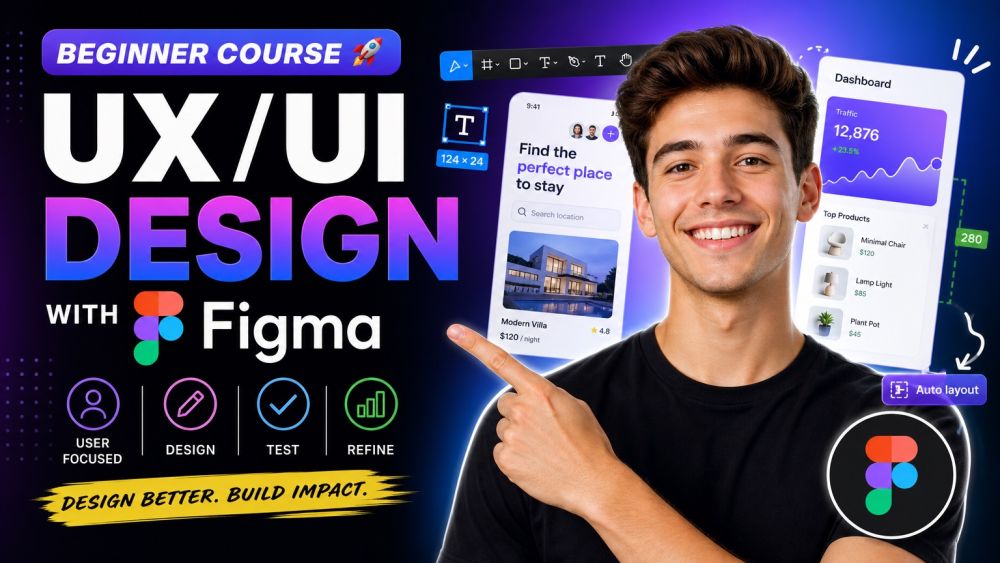
UX/UI Design with Figma

UX/UI Design with Figma

Beginner

Great products are not built by accident — they are designed, tested, and refined with the user in mind, and this beginner course teaches you exactly how. You will start with the foundations: the difference between UX and UI, why user-centered design matters, and the usability principles that separate a product people love from one they abandon. From there you move into research — personas, user journeys, user flows, and the wireframes that turn ideas into a plan before a single pixel is polished. You will study visual design: color theory, typography, spacing, layout grids, and the visual hierarchy that guides a user's eye. Then you get hands-on in Figma itself, the industry-standard design tool: navigating frames and components, building reusable styles, and using auto-layout to design faster and more consistently. Finally, you learn to turn static screens into interactive prototypes, run simple usability tests, gather feedback, and prepare a clean, organized handoff that developers can actually build from. No design degree or prior Figma experience required — just curiosity about how good products get made. By the end you will think like a designer and have the practical Figma skills to design a real interface from a blank canvas to a click-through prototype ready to share.

📋 5 tracks ❓ 200 questions 💡 15 tips 🎬 7 videos ⏱ ~4h

Videos

See all

Tracks

Before you open any design tool, you need to think the way a great product designer thinks. This track builds that foundation. You will learn the real difference between UX (how something works) and UI (how it looks), and why user-centered design beats designing from your own opinion. You will study the core usability principles that make an interface easy or frustrating to use, and walk through the design thinking process — empathize, define, ideate, prototype, test — that professional teams use to solve real problems. You will look at everyday apps through a designer's eyes, spotting what works and what does not. By the end you will understand what UX and UI actually mean and think in terms of the user first.

Good design starts with real people, not assumptions. This track teaches you how to research and plan before you design a single screen. You will learn how to run lightweight user research, build personas that represent your real users, and map user journeys that show what someone feels and needs at each step. You will learn information architecture — organizing content and features so people find what they need without thinking — and how to sketch user flows that map every path through a product. Finally, you will build low-fidelity wireframes to test an idea fast and cheap, before investing in visuals. By the end you will know how to turn a vague idea into a researched, structured plan any team can build from.

A usable structure still needs to look and feel right, and that is what this track teaches. You will learn color theory and how to build a palette that feels intentional, not random, and how typography — pairing fonts, sizing, and line height — shapes readability and tone. You will practice spacing and layout grids, the invisible structure that keeps an interface feeling calm instead of cluttered, and learn how visual hierarchy uses size, weight, and contrast to tell a user's eye exactly where to look first. You will study real interface examples to see these principles in action, and pick up simple rules for consistency across a whole product. By the end you will design screens that are not only usable but genuinely good-looking, with a clear visual system behind every choice.

Figma is the tool professional designers use every day, and this track gets you fluent in it. You will start by learning the Figma interface — panels, layers, and navigation — so you stop hunting for tools and start designing. You will build frames to represent screens at real device sizes, and turn repeated elements into components so a single change updates everywhere it is used. You will create styles for color, text, and effects to keep a whole project consistent, and learn auto-layout, the feature that makes elements resize and reflow automatically like real responsive design. You will practice by rebuilding a simple screen from scratch, applying every skill together. By the end you will move around Figma confidently and build organized, reusable designs instead of one-off static screens.

A great design still has to survive contact with real users and real developers, and this track prepares you for both. You will learn to connect your Figma screens into interactive prototypes with clickable links, transitions, and overlays, so a design feels like a real app before any code is written. You will run simple usability tests, watching someone use your prototype and noticing where they hesitate or get lost, and turn that feedback into concrete design changes. You will also learn how to prepare a clean, well-organized developer handoff — labeled layers, exported assets, spacing and color specs — so engineers can build exactly what you designed without guesswork. By the end you will take a design from idea to a tested, click-through prototype ready to hand to a real development team.

Certification Exam

🏆

Certification Exam

UX/UI Design with Figma

30
Questions
45m
Time Limit
% 70%
To Pass

All tracks · No time pressure to start

🏆

Certification Exam

UX/UI Design with Figma

#

30 Questions

All difficulty levels

45 Minutes

Auto-submits when time expires

%

70% to Pass

Earn your certification badge

No Going Back

Once you answer, you move forward

Tips

See all